After the town became incorporated, it became the official duty of the town to start operating in a legal and orderly manner.
Most of the law officials before the year 1914 were appointed to be marshals during dances, city celebrations and other events that may have warranted a little order.
One older citizen recalls an evening when a dance was being held at the Opera House and they needed a marshal for the night. A certain gentleman volunteered for the job because it paid $1. Toward the end of the evening a fight broke out; people scattered to get out of the way, and a few individuals ran to seek the assistance of the marshal. After a matter of half an hour they indeed found him, hiding beneath the pool table!
Many of the citations handed out in those early days were mainly for fighting or disturbing the peace. Sometimes the offenders were placed in jail to "cool off" or "sober up," whatever seemed the appropriate solution at the time, and then fined a few dollars.
There were some unusual cases, however, that are verified in the town records.
In 1915, a gentleman was fined for speeding through the streets of town in a motor vehicle! Also in that same year, another man was fined for the "misuse of a housekeeper"!
In 1918, a lady was fined $3 for using "profane and indecent language" and a man for stealing "side curtains" from a car.
The last citation handed out in Aspinwall by the town council was in 1952 for reckless driving.
John Schwiesow served as our first town Marshal after the town was incorporated. In 1934, Herman Ehrichs took over the job and remained marshal until 1949. Hugo Kuhl was next, followed by William Soll. There were a few others who assisted over the years, but these were the main ones.
After the year 1955, there is no mention of a town marshal. This job was added to the mayor's responsibilities along with those of the fire marshal and water commissioner. They must have decided these tasks no longer necessitated a full time employee.
Many civic-minded men and women have served as mayors, on the city council, or as town officers during our town's history. We wish we could name them all, but it would be an almost impossible task. We all appreciate the jobs these people have done over the years to keep our little city on "the straight and narrow."
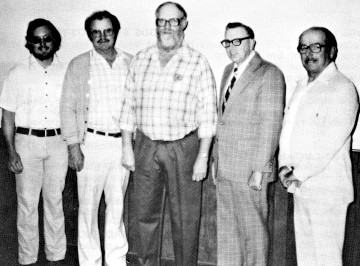
The city officials for 1982 are as follows: Mayor Marcellus (Sal) Grundmeier
Town Clerk Helen Ross
Councilmen Wallace Schroeder, Dean Hupp, Alvin Jansen, Milton Sinow, Allen Soll
Page 132
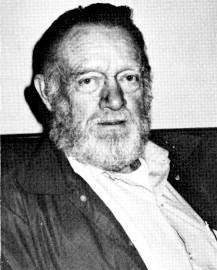
Aspinwall in 1982 is one of the handful of towns which uses no voting machines and no prepared slate of candidates. Voters of the community simply go to the garage, decide who they want in the various offices, write their names on a piece of paper, and put the paper in a box. The ballots are counted by "voting officials."
ASPINWALL WATER
Wells were the only source of water for Aspinwall residents
from 1882 until the mid-1950s. There were several "town wells"
located in various spots where people could fill their pails and bring water to
their homes. Eventually, most residents dug their own wells and installed hand
pumps on the kitchen sinks, making life much easier, especially during the winter months.
Lester Dammann had the first running water system in Aspinwall. He finished covering the water line at his acreage December 7, 1941.
In the mid-1950s the town dug a new well and erected a supply tank. At this time many of the homes were modernized with indoor plumbing.
All this new fangled "equipment" caused one old timer to quip, "What's the world coming to! We used to eat inside and go to the bathroom outside. Now they want us to eat outside and go to the bathroom inside!" This same fellow never did accustom himself to using the indoor "privy."
An older bachelor who lives on a farm south of Aspinwall decided to "modernize" in the summer of 1981 by building a new outhouse. The carpenters he contacted bid a price of $600; the last we heard, he had decided to remodel his old facilities.
Residents of the town of Aspinwall and many area farmers began receiving their water from the West Central Iowa Rural Water Association in July, 1976. The non-profit corporation was organized in 1970 to provide farmers and small towns with a clean, adequate and pollution-free water supply.
Aspinwall was part of the first phase of the multi-million dollar project. This phase, called the Nishnabotna Subsystem, received a $2.1 million loan from the Farm and Home Administration to finance construction of the treatment plant, three wells, and lines to 400 rural customers, the incorporated towns of Templeton, Arcadia, Gray, and Aspinwall, and the unincorporated towns of Roselle and Maple River Junction.
The second phase, a $2.5 million project called the Boyer Subsystem, serves the area between Highway 30 and Lake View with 400 farm users, the towns of Vail and Arcadia, and the unincorporated towns of Mount Carmel and Carnarvon. The third phase was a $2 million project called the North Audubon Subsystem, and serves the northern portion of Audubon County and parts of Carroll County; it has 284 farm users and the unincorporated town of Ross.
The West Central Iowa Rural Water Association, headquartered in Manning, joined the Iowa Rural Water State Association in 1975. Ray Ehlers, who farms south of Aspinwall, has served as president of the local corporation since its beginning, and was elected vice-president of the state association in 1975 and president of the state group in 1980.
Other officers presently serving are Ronnie Frahm, vice-president; Lester Joens, secretary and treasurer; and Bob Barsby, director, all of Manning; and directors Ray Wilhite, Wall Lake; Tony Sander, Arcadia; Dale Schweers, Arcadia; Harold Eich and Kenneth Bromert, Carroll. Gale Moore and Robert Phillips of the Aspinwall area have also served on the board of directors.
ODDS AND ENDS
Alvin Herman, our jeweler, made a business trip to Denison and Charter Oak a few days ago.
Aspinwall News, January 28, 1898
ODDS AND ENDS
CALL & SETTLE (Adv.): All parties knowing themselves indebted to me are
requested to call at the earliest convenience and settle. We are in need of the
money to satisfy debts. Peter Hansen, Aspinwall.
Manning Monitor, January 20, 1899
ODDS AND ENDS
Save money and dress better by having your clothes made to order. Perfect style
and perfect fit guaranteed. Call Mrs. Olga Hansen, Aspinwall.
Ad in August 20, 1931, Manning Monitor
Page 133
ASPINWALL FIRE FIGHTERS
Aspinwall never really had an organized Fire Department, but they did have a
bunch of "rough and ready" guys who were willing to volunteer their
time and effort when the need arose.
John Ehrichs Jr. served as fire chief from about 1915 until 1923; during this time a building was constructed to house the hose cart and supplies. The building later became the Aspinwall jail. When Ehrichs moved, his job was apparently made part of the mayor's work.
Aspinwall had a great number of fires in the early years, which probably prompted the purchase of a hand-pulled hose cart before 1914. For many years this was the only type of fire fighting equipment the town had. At about that same time, a bell was fastened to the top of the jail and everyone was instructed on how and when to use it. Several years later, a siren was purchased to sound the alarm when a fire broke out in the area.
When Hugo Kuhl lived in the house now owned by the Ronald Schillings, he had a wall fire in the early 1950s. The alarm was sounded, the men made a dash to the hose cart, the cart was pulled from the building and made ready, and down the hill to the west side of town the men flew! As they rounded the corner only a half block from the Kuhl home, they spotted the Manning Fire Department rounding the opposite corner! Our men may not have been too speedy, but they were determined!
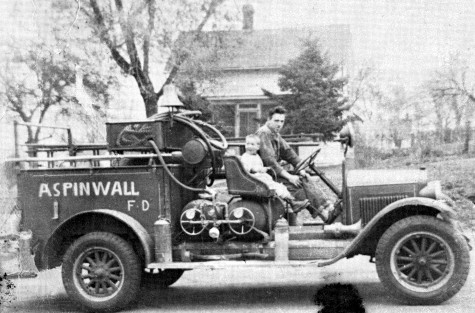
It was shortly after this that the city purchased a 30 year old, 1927 Chevrolet Fire Truck from the Manilla Fire Department. Now we were ready for the fires.
For a long, long, long time, Aspinwall had no fires.
Then, one day, the fire siren sounded! The men ran to the truck and started it up. It started! Hoorah!! As the truck was beginning to roll out the door for its first fire call, something went, "Clunk!" The fire truck stopped! Upon closer observation, it was noted that the fuel line had rusted out and all the gas had run to the ground!
Ed Hinners purchased the fire truck from the town in 1958. The town of Aspinwall then went under the jurisdiction of the Manning Fire Department, as they still are today.
Ron Schilling is the only Aspinwall resident to be a member of the Manning Fire Department, and his wife Susan is a member of the Manning Fire Sirens Auxiliary.
ODDS AND ENDS
On churning day, we had orders for butter from certain
customers, and the store would always take some if there was any left.
Sometimes the people wouldn't get as much as they ordered if we had sold too much cream.
One time my brother Henry was told that he would have to churn the cream before
he could go with his buddies. He was using a barrel churn, and as he sat
turning and turning, George Brady came by to see if Henry was ready to go. As
they were talking, George put out his hand to touch the churn as it went
around, and accidentally pulled out the cork. Cream spilled all over the
sidewalk. Needless to say, there was no butter that day, and we had some disappointed customers.
Gertie (Schroeder) Mork
Page 134
TELEPHONES
Production of the telephone began in 1877, and by 1886, the town of Denison
was being connected, to towns to the east by telephone lines. A private line
was strung from Audubon to Manning in 1899, and the town of Manning had a
telephone franchise in 1901 with a long list of customers.
In Aspinwall, we got our first telephone in 1902, and it was the only phone in town for quite some time.
John Stammer and Adam Wiese were partners in the store at that time and installed a telephone for their benefit and for the benefit of the town residents. When a doctor was needed or another emergency arose, someone would run to the store, wake up John (who had his living quarters in the back of the store), and ask to use the telephone. Many times John was awakened by the frantic pounding on the door and the hollering from "without"!
A few years later the "old ladies' gossip line," as one elderly gent preferred to call it, was available in many homes in Aspinwall.
Frank Ehrichs, who was a big hog and cattle buyer for many years, had a system all worked out concerning the old party lines. At a certain time of the day, he would instruct the operator to give "one long ring"; the farmers in the area would then pick up their phones and hear what the hog and cattle markets were doing for that day.
Telephone service today in Aspinwall and the surrounding area is provided by the United Telephone Company of Iowa; we are on Manning lines which is sometimes an inconvenience because Aspinwall children attend school in Manilla and calling there is always long-distance. But we wouldn't want to give up our telephones, which have become almost a necessity in our homes.
Still, it will be a long time before the residents of Aspinwall forget the days when they had to make that "mad dash" to the store, wake up John Stammer, and use that old crank telephone.
ODDS AND ENDS
Now is the time to buy a disc cultivator, a shovel
cultivator. We have them all and they are the leaders in their class. Don't
forget that our line is complete in machinery and gasoline engines. We will
save you money on everything you buy. Let us have your order for binder twine
now. Ehrichs Brothers
Manning Monitor, June 20, 1912
ODDS AND ENDS
For Sale: Weber Fifth Wheel Wagon. Ben Ehrichs,
Aspinwall
Manning Monitor, October 18, 1917
ELECTRICITY IN ASPINWALL
Many older people fondly remember the "warm glow of the
lantern light" and the "eerie shadows" that were cast against the walls.
People in those days were content with this small source of light when evening fell and especially during those long, winter months.
Today, we take for granted the ever-present light switch that only demands the touch of a finger to spread light throughout the entire home. And, how often don't we complain when we are without this great "necessity" for a short period of time?
Aspinwall residents were without this modern convenience for a much longer time than surrounding towns. By 1920, plans were beginning to be developed, and $3000 was issued for the "construction of a lighting system."
But it wasn't until October 14, 1924, that Aspinwall Mayor George Schade and Town Clerk J.J. Uselding signed Ordinance Number 13, which authorized Iowa Light, Heat and Power Company of Carroll to serve the citizens of Aspinwall. This electric franchise was for a period of 25 years and this granted the company the right to construct an electric light, heat and power system in town.
The franchise election was held November 17, 1924 and was passed, and the Carroll company was awarded the franchise. It was accepted by Iowa Light, Heat and Power Company of Carroll, Iowa, November 26, 1924, and signed by Mr. F.H. Hoopner, Vice President of the Company.
The company was given 90 days to put up poles, string the lines and complete the system, which they did.
The electric franchise was up in November, 1949, and the company, then called Iowa Public Service Company, was given another 25 year franchise; in 1973 they were granted their third 25 year franchise, which the Iowa Public Service is now operating under.
ODDS AND ENDS
It cost $168,000 to build about 145 miles of
electrical lines to serve 349 members of the South Crawford Rural Electric
Association in Carroll, Crawford, and Sac Counties.
Manning Monitor, January 12, 1939
ODDS AND ENDS
The many friends of Mrs. Emil Wegner will be
interested to learn that she became the mother of a little girl who was born
Sunday, April 23. Mother and babe are being cared for in the home of her
parents, Mr. and Mrs. Gus Vehrs in Manning. It seems rather coincidental but
April 23 was also the birth date of the little baby's deceased father, who died
suddenly April 15.
Manning Monitor, April 27, 1939