Anyone who has pictures, information, corrections and wants to help with this web page history project --- please contact
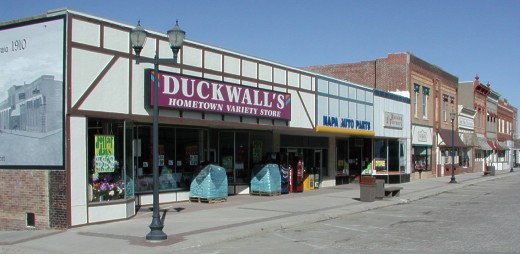
Dave Kusel.Below: looking northwest from the corner of 4th & main street.
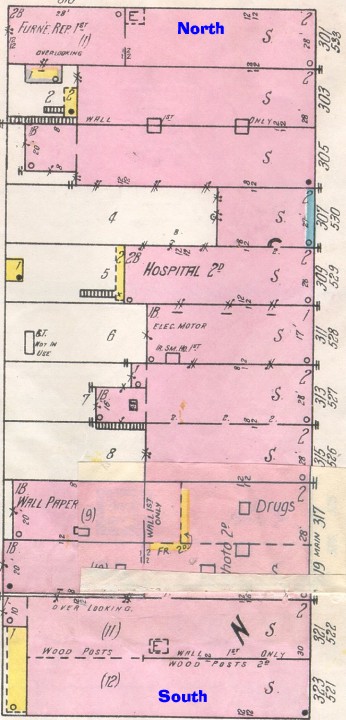
Below: a 1927 Plat of this block --- Main Street on the right side.
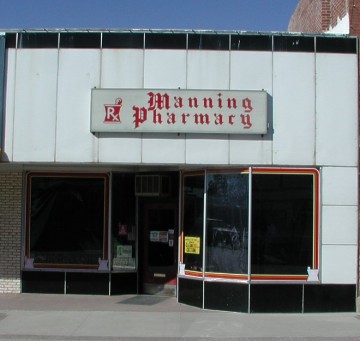
Manning Pharmacy
317 Main Street
1 Lewis and Grau drug store (J.A. Lewis and Grover Herman Grau)
2 Lewis & Reinhold Co. Drug Store (John A. Lewis and August Reinhold)
2a Dr. C.L. Wilhite veterinarian office 1927 - 1948
3 Lewis & Reinhold Co. Drug Store (Arthur Rix and Orval Fink)
4 Crabb's Pharmacy (Tom Crabb)
5 The Manning Pharmacy (Robert & Lois Stessman) 2003
Upstairs:
1 Lyden Studio
2 Nan's Beauty Shoppe (Mrs. Nannie Miller)
Local drug store has served
many needs through the years
The history of Manning's drug store dates back to 1883 when a Dr. A.H. Hull opened a drug store known as Hull Drug Company. After an exchange of ownership, Mr. J.A. Lewis, a graduate of the old Highland Park School of Pharmacy, bought in to the business and in 1892, he joined in a partnership with Mr. Herman Grau. They operated under the firm name of Lewis and Grau and incorporated a jewelry department and watch repair service operated by a Wm. Metzger.
In 1894, the firm built the building now occupied by Billie's Flowers, as can still be identified by the "Drugs 1894" sign in the curved cap at the top of the building.
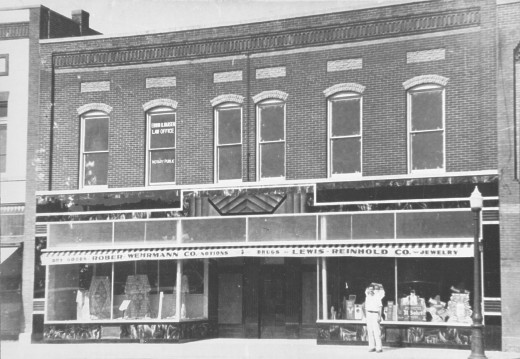
In 1905, Mr. A.J. Reinhold, a pharmacy graduate of Northwestern University in Chicago, purchased the interests of Grau and Metzger and the firm became known as the Lewis-Reinhold Co. In 1912, it was incorporated as such with the distinction of a store having two pharmacists. Later the company moved to a double-front location, one-half of which is now the present site.
This double-front store featured a big, marble-topped, 15-foot long soda fountain across the middle front part of the store with the accompanying ice cream chairs and tables. The ice cream was purchased from the Manning Creamery Company which delivered each flavor in a stainless steel five-gallon cylindrical container about 12 inches in diameter. The containers were put down into individual wells below the counter top each section large enough in diameter to allow ice to be crushed and packed around the canisters. A baseball bat was a handy stomper to pack the ice furnished by the Creamery company.
This fountain was in direct competition with a similar one in the double-front Schelldorf Drug Store across the street where the Village Mall is now located. Another soda fountain was in the R.H. Claussen Drug Store, a few doors north of the Schelldorf Drug Store, and the fourth one was in the Goody Garden Ice Cream Parlor, where Country Interiors is now located.
The Lewis-Reinhold Company also sold the Victrola phonographs and maintained a music room in the northwest part of the building. It was used for Victrola demonstrations and held a large stock of sheet music and phonograph records. If you wanted to buy a record you could hear it played before you bought it. The drug store across the street sold Edison phonographs and pianos. The Mueller Furniture Store sold Brunswick phonographs.
The Claussen Drug Store sold Columbia phonographs.
Near the front part of the south half of the Lewis-Reinhold store was an eye-catching aquarium about five feet long filled with dozens of species of small goldfish, an added attraction for the customers. By 1923, the store had consolidated into the south half of the building and Dr. W.H. Fink, an optometrist and jeweler was added to the firm. Changes in merchandising and available space had dictated the discontinuance of the soda fountain and music business and was replaced by a jewelry department and an optical exam room. Very little space was needed for a pharmacy department so a large part of the rear of the store was used for a paint and wallpaper department. The local doctors dispensed most of their medicines.
During prohibition times the store did a land-office business in the sale of half-pint and quart bottles.
In the late 30's and 40's the store served as headquarters for Dr. C.L. Wilhite, a local veterinarian. Since this was before the advent of farm stores in this area, the store carried many of the veterinary medicines used by Dr. Wilhite.
Bags of cattle feed supplements were stocked in the basement and sold out the back doors. Farmers drove their pickups in the alley and above the doors pushed a button that rang a bell upstairs.
The basement also stocked 50 gallon barrels of mineral oil and lime sulphur that was bottled for resale upstairs, carrying the Lewis-Reinhold label. They also had their label on six-ounce bottles at their own formulated hand lotion they called Cornhuskers Lotion.
The store also carried the Rexall Drug franchise and featured the Rexall products along with their national brand inventory. Twice a year they participated in the farmers national Rexall promotion of their one-cent sale whereby the purchase of a Rexall item entitled the purchase to another like item for an additional one cent. These sales were so popular that many people referred to the store as the Rexall Store.
In 1945, Art Rix purchased the J.A. Lewis interests and a little over a year later persuaded Dr. Fink's son, Orval, to purchase the A.J. Reinhold interests. Orval was a graduate of the Drake School of Pharmacy and was managing a Walgreen store in Clinton, Iowa.
The new owners remodeled the entire basement and installed a snack shop. Cake and Pepsi machines were installed and home-cooked pies, donuts, bars and cookies were offered. The project was practically self-service. After a store employee made the coffee, the rest was up to the customer. There was no cash register and change was made out of a dish. Profit-wise, the honor system did very well.
During this same year, the Wyatt Hospital was purchased by three young doctors of osteopathy, all of whom were prescription writers. Lewis-Reinhold Company then moved the wallpaper and paint department to the basement and used the newly available space for an enlarged, up-to-date completely stocked pharmacy department.
With the passing of Dr. Fink the watch repair and jewelry department was replaced with a full line of Fostoria Crystalware which attracted many customers from a wide trade area. The company also featured a large cosmetic department of the top brands and several times each year a representative of the Richard Hudnut Company conducted a free clinic in the store on make-up and gave facials.
In 1972, Art Rix sold his interests to Orval Fink, retaining the wallpaper and paint department until 1978, when he retired after 50 years on Main Street, beginning with joining the family publishing business in 1928.
A year later, Orval Fink sold the store to Tom Crabb, who operated it as the Crabb Pharmacy until Sept.1, 1988, when he sold it to Bob and Lois Stessman, the present operators of the Manning Pharmacy.
Rober Wehrmann left and
Lewis Reinhold Co. right which is now Manning Pharmacy.