Our earliest reference to a barber is in 1884, when W.J. Larue reportedly had a shop open two days a week, and by 1886, Aspinwall apparently had more than one barber to serve its 300 people. In 1901, we find the report that a fire which started in the barber shop destroyed the entire business block on the east side of Main Street.
Pete Siem came to Aspinwall as a barber at the old wooden building at the southwest corner of Main Street. He barbered several years, then went to the service, and after returning from World War I duty, bought the "refreshment stand." He continued the barber shop in the south side of the building until the building was lost in the 1924 fire. Siem then bought the opera house at the northeast corner of the block, and moved the barber chair there. The building burned in 1932; Siem left Aspinwall and opened a barber shop in Manning, which he operated for more than 20 years.
The pool hall now known as the Aspinwall Tap was built in 1932, and owner Emil Ehrichs hired Francis Lally as the barber there. After several years, Lally moved to Des Moines and his brother-in-law Tommie Rowan took over the shop. Fred Boyens, who had bought the tavern in 1934, paid Tommie a guaranteed salary of $10 a week during the Depression years.
Rowan moved to Manilla in 1938, and Charlie Hudson from Neola barbered for Boyens. Finally, Earl Jentsch began coming to Aspinwall designated days of the week to work at the barber shop. The barber chair was taken out in about 1946, when Ed Hinners bought the tavern and made an apartment in the former barber shop area.
Men, women and children had taken their turns in the Aspinwall barber shop; although we have had no barber in town since Jentsch closed the shop, we now have something not found in earlier years: a beautician.
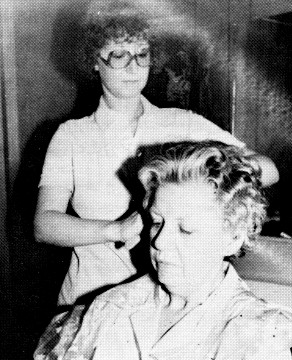
Carol had already attained her beautician's license from the American Beauty Academy in Des Moines, so, in August of that same year, she moved a trailer house to a lot on the east side of Main Street, and Aspinwall's first beauty shop became a reality. To the best of our knowledge, and hers, her shop is the first of its kind in our little community.
In 1970, after her marriage to Dallas Lile, Carol continued to serve the ladies in the Aspinwall area and beyond. Her business is still flourishing today, and you might even say Carol has gone "co-ed"! Some of the male gender, as well, have had their hair styled and cut at the Salon DeBeaute.
BLACKSMITHS
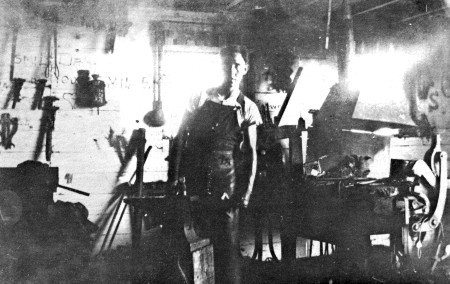
The job of the village blacksmith was hot, physically demanding, and of
great importance to early farmers and townspeople alike; the smithy was called
on to repair wagon wheels and tongues, straighten bent pieces of equipment,
sharpen plow lathes, put shoes on horses, and do 101 other jobs needing iron
and steel. Often the blacksmith made or repaired wagons, buggies, and machinery as well.
The shop of the blacksmith often drew an audience of both young and old, who were fascinated by the work. John Babik, now retired and living in Omaha, recalls heading to the blacksmith shop nearly every day; young Johnny sat under a huge shade tree watching, as the words of The Village Blacksmith poem he memorized in school danced through his mind.
The shop was located on the south side of
Continued from page 39
Railroad Street, about a half block east of Main Street; we don't know if any were at a different location. According to our earliest records, A.G. Mueller, in 1884, "manufactured harnesses, whips, curry combs, brushes, and collars, and did repair work neatly" at a shop in Aspinwall; also in 1884, Paul J.F. Wegner operated a wagon shop. When the new town of Manilla was founded in late 1886, Wegner was one who bought a lot and moved his shop there.
In 1886, we have a reference to a Mr. Vogt, who "attends the wants of those needing blacksmithing or wagon work"; he apparently sold the business to Andrew Boyens, who had learned the blacksmith's trade in Germany and had worked in Manning for about a year before moving to Aspinwall. Boyens and his wife Elizabeth lived in the house next to the blacksmith shop which he owned for 12 years. It was announced in the December 17, 1897 Manning Monitor that Boyens had sold his blacksmith shop to Henry Kuser of Logan, although Mr. Boyens would retain possession of the shop until March 1. Boyens rented the Ahlert property and lived there for two years before moving to a farm in Iowa Township.
Peter Christiansen took over the shop and moved into the house in about 1906, and he continued the business until 1914 when he and his family moved to Montana. George Herman, who attended the Aspinwall School from 1903 until 1912, apparently married and entered the blacksmith business in about 1914, operating it for several years. The property, including both the house and shop, was purchased by retired farmer William Ranniger in 1920. Ranniger lived in the house but rented out the blacksmith shop until his death in 1940.