Page 324
Page 325
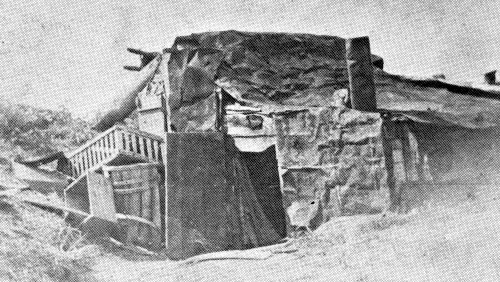
UNUSUAL HOUSES
Throughout the years, Aspinwall area people have been quite adept at using
natural resources to construct their homes. Some of the first settlers lived in
caves, dugouts, or in sod houses until lumber could be brought in to make new
residences. In years not too far gone by, we have heard of some people still
living in caves, dugouts, and sod houses.
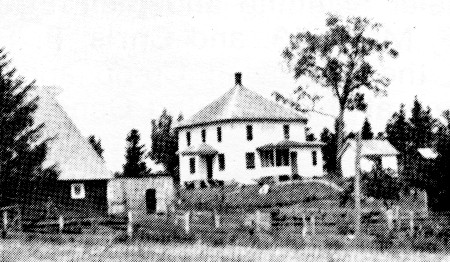
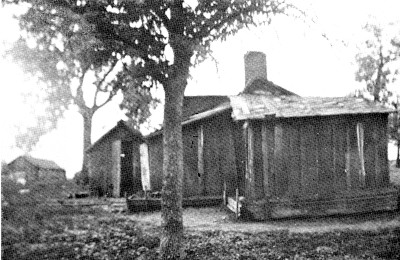
The house shown above was the home of brothers Marty and Brian McMahon and
their sister until the spring of 1940. The house, located about two miles west
and 3/4 mile north of Aspinwall, was made of boards, had no windows, and
included a dirt floor. Most of the cooking was done in a coffee pot, recalls
one visitor, who watched as one of the brothers first boiled eggs in the pot
and then made the coffee. Marty was the "road boss" for Iowa Township
and helped Brian farm the 280 acre farm. The two brothers, always called
"The Big Boys," became quite well known for their replies during
every conversation; one always said "By Yippy" and the other would add
"By Cripe."
ODDS AND ENDS
When I first learned that our family was going to move to Aspinwall because Dad
was going to run the garage, I was, to say the least, devastated! Aspinwall! A
little "hick" town where nobody was nobody! My Manning friends warned
me about the "strange" people who befriended no one. I was told the
pool hall was a "den of drunks and thieves," and I was especially
warned about those "wild" Schilling boys who roamed the streets!
Well, as it turned out, the people of Aspinwall were warm and friendly and
always willing to lend a helping hand, the pool hall was a fun place where even
kids could go and play pool and buy ice cream cones, and, as far as those
"wild" Schilling boys were concerned ... Well, I married one!
Susan (Grundmeier) Schilling
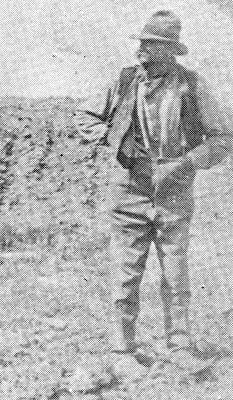
"POTATO JOHN"
ODDS AND ENDS
James Wood and John Wilson of Vail started a brick yard three miles south of
Vail in 1874.
History of Crawford County, published in 1911
Page 326
BRUS-LAGE CENTURY FARM
Mr. and Mrs. Christopher Lage and their sons Henry and Hans left Schoenbery (probably Schönberg),
Probstei, in Holstein, Germany in 1835, crossing the Atlantic Ocean for seven
weeks in a little sailboat. They first located in Clinton, Iowa, moving into a
sod house on a farm. The boys received their education there.
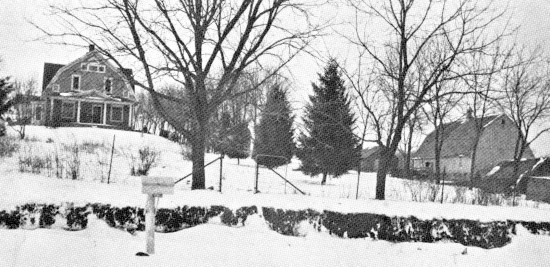
Henry and Hans came to Crawford County in 1873. They purchased a 240 acre farm in Hayes Township, Section 36. In 1876 the Lage brothers moved on their land and Henry bought another 90 acres across the road in Section 1, Iowa Township, which is 2 1/2 miles north and 1 1/4 miles east of Aspinwall.
Hans and his wife Marie Myers had four children, Ida, Emma, Pauline and Gus. After Hans passed away, Marie married August Eikmeir, and they had a daughter Louise (Eikmeir) Hoelcher.
Emma Lage married Otto Adolph Brus February 22, 1905. They purchased the 120 acre farm from Marie Lage Eikmeir in 1910. Emma and Otto remained on this farm their entire life, and raised four sons, Arnold, Elmer, Vertus and Willis.
Arnold married Luella Kahl in 1939, and they had three children, Wayne, Robert and Georgia. Arnold purchased the homestead in 1948.
The family had a herd of Holstein milk cows until 1966, when they entered the Hereford beef cattle business. In earlier years, Otto had Rhode Island Red chickens and sold hatching eggs. He later switched to New Hampshire Red chickens, which were continued by Arnold. They had about 1,400 chickens every year and sold hatching eggs.
In 1939, CCC workers put in contour fences and made the farm pond bigger. The hog house burned down in 1954, and a new one was built the same year. A new corn crib was added in 1964 and a cattle shed in 1967.
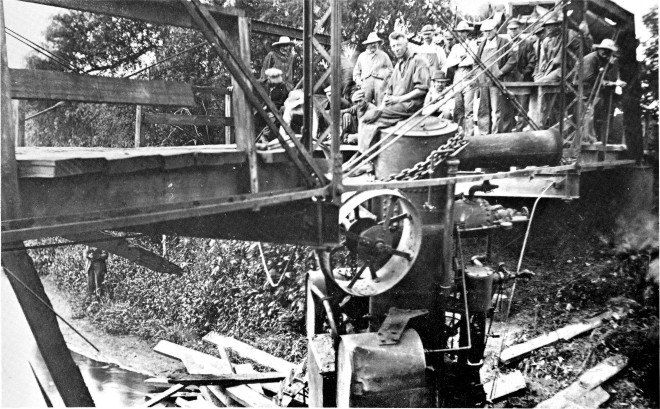
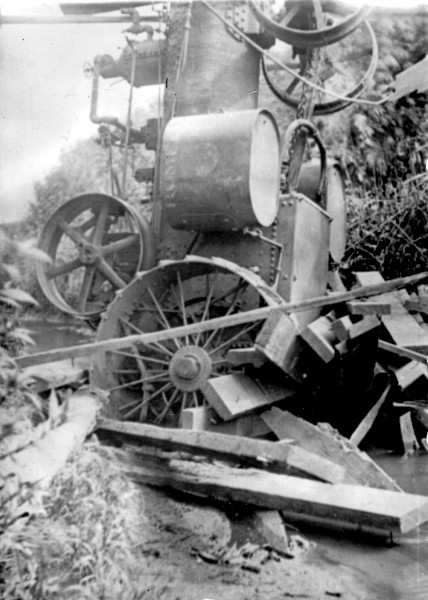
The mishap occurred on the Shelby-Crawford County line, a half-mile north and a half-mile east of Botna. Hans Pfoltner and Frank Stoelk were on the engine and went down with it. Frank pulled the planks off Hans, who was burned by the steam. Frank suffered several broken ribs.
Albert Stoelk, Frank's brother, is shown sitting on the steam engine; their father Henry is standing under the bridge railing. Henry Steen is on Albert's right side.
Page 327
JOHN A. EHRICHS
CENTURY FARM
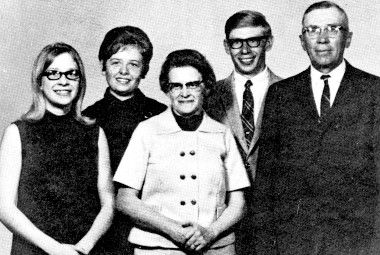
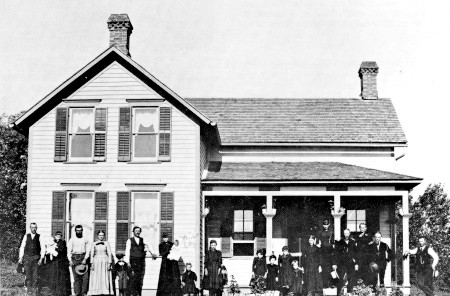
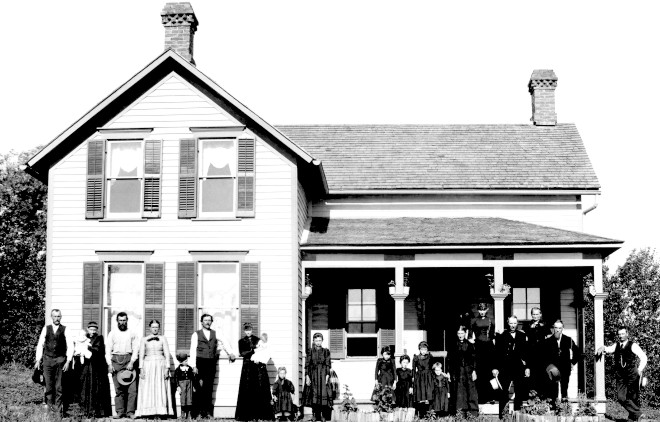
John Ehrichs, an early pioneer of Crawford County, was one of the first settlers who helped break up the prairie and build the land in its present state. He was a hard worker and a good provider for his family. He was honest in all his dealings and was a good, kind man to all who knew him.
John Ehrichs was born March 6, 1846, in Schleswig-Holstein, Germany and he came to America 20 years later, settling in Clinton County, Iowa. Here he worked as a hired man. He was united in marriage with Anna Jurgensen January 26, 1872.
They lived in Clinton County for nine years and in 1881 moved to a farm near Deloit, where they maintained a home for a year. They then moved to a farm five miles northwest of Aspinwall. In 1907 they retired and moved to Aspinwall. Mrs. Ehrichs passed away February 9, 1923, and Mr. Ehrichs passed away March 11, 1934. They had 14 children, all now deceased.
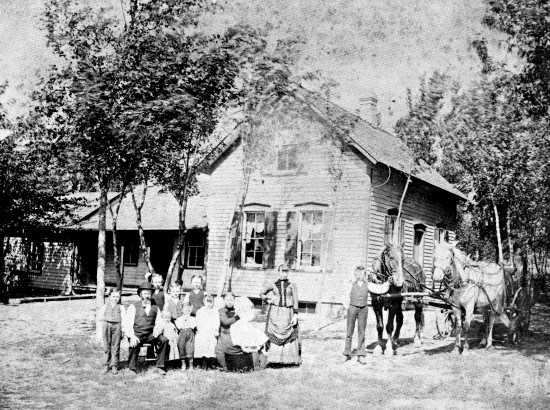
Alfred, seventh son of John Sr., was born on
Continued from page 327
the century farm September 16, 1882. Clara Brus was born July 27, 1885. Alfred and Clara were married September 29, 1909, and had one son, John A.
Father and son did custom work like corn shelling in their neighborhood and had the threshing ring around the Aspinwall area.
Alfred passed away April 28, 1961, after living on this farm 60 years. His wife passed away on March 8, 1958.
John A. attended school in Aspinwall. He married Elda Ewoldt June 24, 1942, and they lived on this farm until retiring to Manning in 1975. They had three children, John E., Rosemary and Linda.
Rosemary and husband Robert Stamm have two children, Sara and Bobby. They live in Columbus, Nebraska. Linda and husband Jim Wietfeld have two children, Brian and Jamie, and live near Leigh, Nebraska.
John E. is the fourth generation to live on the farm which his great-grandfather purchased November 16, 1881, in Iowa Township, Crawford County. The farm received recognition as a Century Farm in 1981 at the Iowa State Fair.
FIELWEBER-LAGE
CENTURY FARM
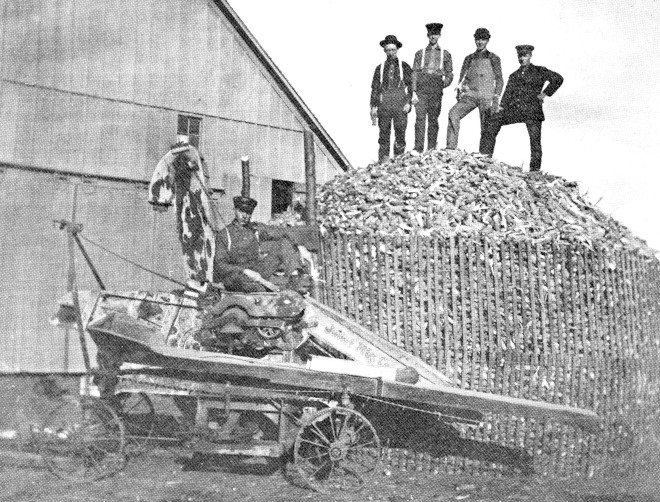
The Art Fielweber farm 2 1/2 miles north and 1 1/2 miles east of Aspinwall was
one of the first in this area to be recognized as a Century Farm. The Crawford
County farm, which originally included 240 acres in Hayes Township, was
purchased in 1876 by brothers Hans and Henry Lage; they paid $4.50 an acre for part of the land.
Until they married, the brothers did not live on their farm. They later built two sets of buildings and moved there with their families. Each farmed 120 acres, with Henry later adding 90 acres on the south side of the road in Iowa Township. Hans' section is now owned by the Arnold Brus family, and a 60 acre portion of the original farm belongs to Herman Lage.
Henry and his wife Eline had three boys, John, Herman and Alfred. Alfred remained on the farm his entire life; he died in 1964. Alfred was instrumental in creating the South Crawford Rural Electric Cooperative, and the farm was one of the first to receive electricity in the fall of 1937.
Alfred and his wife had one daughter, Frances, who also lived on the farm her entire life. She married Art Fielweber, and he moved to the farm when he returned from military duty in World War II. Art worked as a carpenter in Manning until his father-in-law's death, and then began to farm the land. Frances died March 10, 1980.
The original house is still being used. A kitchen was added in earlier years, and the home was modernized and remodeled in 1946.
Alfred Lage was well known for his purebred Poland China hogs, and he won many ribbons with them at fairs. The farm included some Holstein milk cows in earlier years, and since 1935, Angus beef cattle have been raised there.
Soil conservation practices were started on the farm as early as 1940, when a pond was built. Since then, many trees have been planted and the land has been terraced and contoured.