TRI-COUNTY SOCIAL CLUB
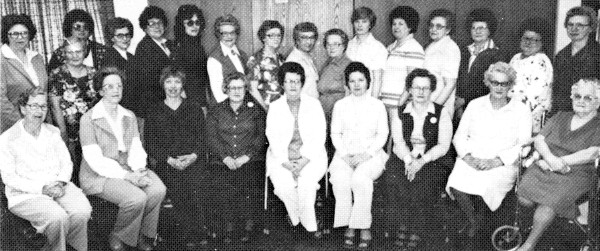
The Tri-County Social Club was organized in October of 1933, as the Botna
Ladies Aid; there were 22 members and Mrs. Emma Campbell was president. Early
meetings were held in the Botna church basement. In 1937, the name of the club
was changed to The Botna Social Club, and to the Friendly Hour Club in 1951.
The most recent change was made in October of 1979, when they became known as
the Tri-County Club, because members are from three counties: Carroll,
Crawford, and Shelby. They meet the third Thursday of the month.
The club was first and foremost an afternoon to get away and enjoy the company of others. Attendance was good, as displayed by their determination to get to a meeting; one of the husbands brought them with horses and wagon on a muddy March afternoon when the club was held at Lillie Franks' house.
In the beginning, dues were 5c per month and they had a 10c Christmas gift exchange. Now dues are $3.00 per year and the gift exchange for Christmas is $2.50.
The club is very civic minded and they contribute to many worthy causes. A few of these are the Cancer Fund, the American Field Service Chapter, the March of Dimes and the Red Cross. Twice a year they entertain the residents of the Manning Plaza at their Birthday party. They also help at the Aspinwall and Manning celebration days.
The present officers of the club are:
President Pat Vennink
Vice President Carol Muhlbauer
Secretary Mary Ann Renze
Treasurer Kay Otto
Reporter Mercedes Bowers
The club roll includes the following women: Lillian Andresen, Elda Barten, Lucille Campbell, Dorothy Dales, Minnie Dales, Phylis Ehlers, Carol Muhlbauer, Irene Jansen, Genelle Kienast, Delores Kuhn, Linda McCollum, Shirley McCollum, Mercedes Bowers, Kay Otto, Dorothea Musfeldt, Rose Ann Nulle, Mary Ann Renze, Mary Souter, Viola Spieker, Norma Taggart, Pat Vennink, Selma Vennink, Honorary Member Gladys Ramsey, and Associate Members Edith Stoberl and Nell Witt.
The club made a quilt which was raffled off, and gave half of the proceeds to the Manning Centennial Committee. They planned a bake sale for the spring of 1982, with the proceeds going to the Aspinwall Centennial fund.
ODDS AND ENDS
ASPINWALL MEAT SHOOT
Last Sunday at Aspinwall there was a large gathering to enjoy the meat
shoot and some very good shooting was done. Fred Musfeldt proved to have the
steadiest nerve and clearest eye and carried off first prize. The following
were the winners:
1. Fred Musfeldt
2. Hugo Brus
3. John Vehrs
4. John Schwiesow
5. William Wegner
6. Gus Vinke
7. Ben Ehrichs
8. Frank Hinze
9. August Ehrichs
10. Fred Hansen
11. Louie Thomsen
12. John Mohr
In the ladies contest, Mrs. Alfred Ehrichs carried off first prize. The
following were the winners:
1. Mrs. Alfred Ehrichs
2. Mrs. Fred Musfeldt
3. Mrs. Walter Ossenkop
4. Mrs. Jacob Carstens
5. Mrs. Henry Kai
6. Mrs. Emil Klindt
7. Miss Emma Joens
8. Mrs. Fritz Lohrmann
Manning Monitor, September 22, 1916
Page 162
4-H CLUBS
A number of young farm kids in the Aspinwall area got their first taste of
raising livestock through participation in 4-H. A boys' club headquartered in
Westside was active as early as the mid-1920s, with Albert Hill, the Ossenkops,
and Clarence Stammer among the members from this
vicinity. Under the leadership of Frank Hoffmann, the boys showed at the
Crawford County and Iowa State Fairs, the Westside Achievement Show, and at Ak-Sar-Ben in Omaha.
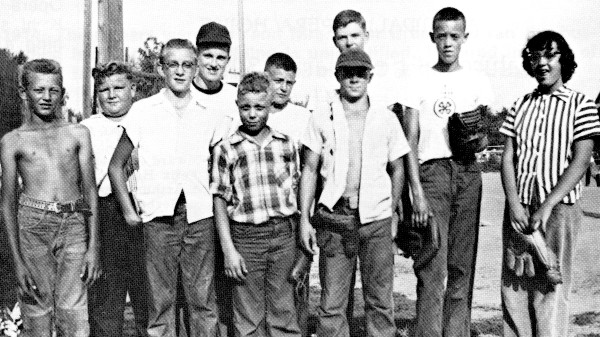
In later years, 4-Hers from this area were grouped with the Manilla Blue Ribbons. Meetings in the 1950s were held at the Manilla Presbyterian Church; the group eventually got so large that it was split into two clubs. The local group was called the "HI 4-H Club," taking the name from "Hayes" and "Iowa" Townships. Earl Justice was the first leader; subsequent leaders included Bob McCaffery, Frenz Lohrmann, Marvin Kuhl, and Clarence Stammer.
The HI Club began in the late-1950s with about 20 members, but by the mid-1960s, the membership had declined to the point that the club disbanded.
For a time, there was also a girls' 4-H Club in this area, called the Sunshine Sisters. As with the boys' club, it too disbanded; most 4-Hers from this area now belong to clubs at Manning or Manilla.
WILLING WORKERS CLUB
A group of farm women met monthly in the 1920s and
1930s in a club called the Willing Workers, and they did just that; the women
would meet at one of the homes to help the person sew, can, or do whatever work
needed done. One member, Mrs. John Vennink, had a machine which canned
vegetables, which was quite a novelty.
The women met year around, and paid yearly dues of 15 cents. They held a picnic every summer, usually at the Manilla Park but sometimes at a home.
Most of the members lived south and west of Aspinwall. They included Mrs. John Derner, Mrs. Pete Karsten, Mrs. Walter Webster, Mrs. Herman "Speed" Pfoltner, Mrs. John Brus, Mrs. Claus Thomssen, Mrs. Ed McMahon, Mrs. John Joens, Mrs. John Vennink, Mrs. Ralph Justice, Mrs. George Holdsworth, Mrs. Bill Wiese, Mrs. Charlie Gessman, Mrs. Louie Reinholdt, and Mrs. Herman Neuhofel.
ODDS AND ENDS
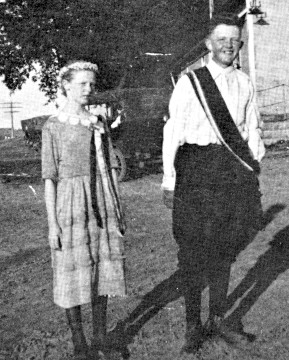
I remember Children's Day. We got new dresses made and had new slippers. Amanda
Schroeder was kept busy putting our hair in rags to have long curls. One year I
won a prize for throwing balls in a small barrel. It was four yards of dress material.
Malinda (Ehrichs) Anderson
ODDS AND ENDS
As none of the neighboring towns are going to celebrate on the Fourth of July,
the citizens of Aspinwall have decided on an old time celebration.
Manning Monitor, June 1, 1895
ODDS AND ENDS
John Schilling, Emil Sinow, Herman Pfoltner and Charles
Schroeder made a fishing trip to Storm Lake Monday, returning home Tuesday.
Aspinwall News of Manning Monitor, May 25, 1939
Page 163
Aspinwall Opera House
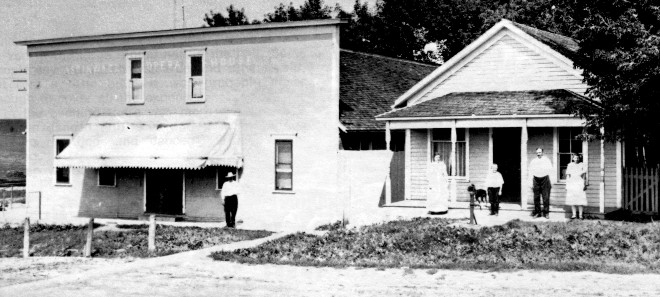
The Aspinwall Opera House was probably the center for most of the major
entertainment in town until its demise in 1932.
Children's Day was probably the greatest crowd drawer, but other dances, such as the popular Masquerade Balls, were held frequently and enjoyed by all.
A variety of orchestras played for these dances and many people will remember such names as The Westside Orchestra, which featured a xylophone player who was very good, Hans Orchestra from Manilla, The Thomsen Orchestra, The Kruse Orchestra, The Ruby Trio, and Pete's Peerless Players.
The dances were usually held from 8 p.m. until 12 or 2 a.m., but, we have heard a few rumors that say they may have lasted "Till daylight dawned!"
In 1927, a new Ford was given away and Dethlef Kruse of Westside won it. Pete Siem, who was the owner of the Opera House at that time, and Pete Kuhl sold over 1200 tickets. That evening a dance was held at the hall and Pete's Peerless Players entertained.
In 1913, they even offered roller-skating at the Opera House for the entire family. It didn't go over too well, so it was soon forgotten.
Home Talent Shows were also held at the Opera House and featured such early actors as George and Milda Peters, Mike Wegner, Florence Schroeder, Leona and Claire Lally and Helen Wiese.
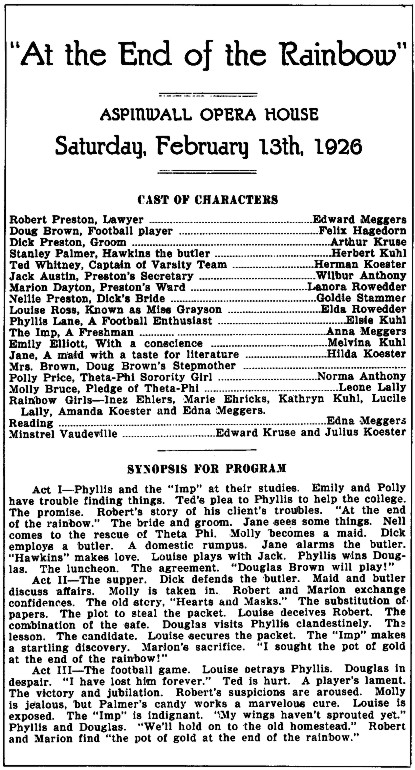
February 13, 1926, a home talent production called "At the End of the Rainbow" was presented at the Opera House. Leona Lally, who was teaching Iowa Township No. 2 school at that time, was the director and also an actress in the play. She wanted to hold the production at the Opera House, which didn't have a curtain for the stage. She talked Pete Siem into buying one if he got paid a flat fee for having the show there. Pete was a little "leery" of the show's success at first and wanted payment determined ahead of time. Apparently there was enough advance ticket sales and enthusiasm around town that Siem later came to Miss Lally and wanted a percentage of the total take, but she said no!
Practices for this production were held in the rural school 1 1/2 miles north and one mile west of town, and the actors, including Goldie Meeves, living on farms found themselves walking to school every night through the snow for rehearsals. There weren't enough girls for the cast, so the teacher's sister, Lucille, helped out and one girl, Hilda Koester, had two small parts; there were too many boys so Ed Kruse and Julius Koester were "black-faced" and were the vaudeville minstrels.
Page 164
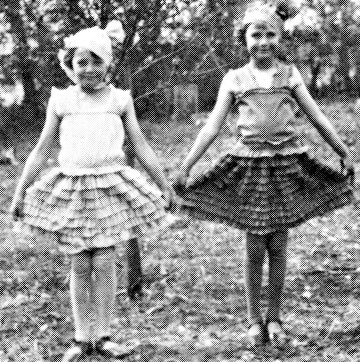
The "Rainbow Girls" wore dresses made out of crepe paper, which were all different colors to represent the colors of the rainbow.
On the night before the production, one of the main actors was arrested for bootlegging! Somehow his parents talked the authorities into releasing him for the performance; he had to return to jail immediately afterwards.
School programs were held at the Opera House over the years. Many people remember watching the programs by the light of the row of lanterns sitting on the front of the stage to form "floodlights"; several were also suspended from the ceiling to provide extra lighting.
In 1932, when the Opera House burned, the years of fun and entertainment in that wonderful old hall came to an end.
Page 165
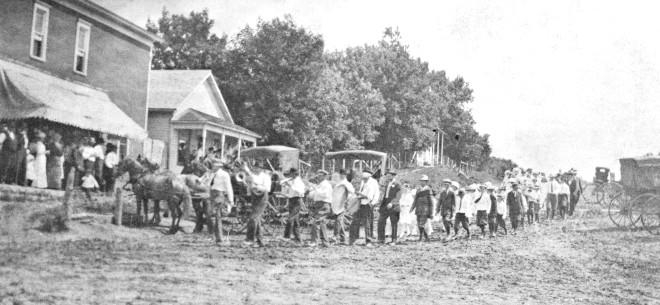
KINDERBALL OR CHILDREN'S DAY
Kinderball or Children's Day was the highlight of the year for citizens of all
ages in Aspinwall's early days. It was held at the Aspinwall Opera House every June.
Kinderball is a German celebration brought to this country by our early ancestors; we believe our German founding fathers created a similar day in Aspinwall around 1884. At first, a German "Verein" or club probably sponsored the Kinderfest, but later the owners of the Opera House planned the celebration.
The Aspinwall Opera House had several different owners throughout the years, but every one of them went "all out" to make Children's Day a memorable occasion for all. Much of the hard work and a majority of the expenses of the day-long event were shouldered by the owners.
For weeks before the big day, all types of preparations were underway all over town. The children began earning and saving pennies as to have a little spending money; the girls were outfitted in new dresses (we were told at one time dresses had to be all white!), the boys had new shirts to wear, and the parents were busy preparing for company that would come from a distance and perhaps spend the night, or even a day or two.
For the owners of the Opera House it was a time for baking loaf after loaf of bread and an almost endless assortment of cakes. You must remember this was before cake mixes, electric mixers, "boughten" bread and freezers!
When the day finally arrived everyone was anxious and excited. Registration was held first and then the big parade! Someone always led the parade carrying the U.S. Flag, followed by a band leading the children through the streets of town and then back to the Opera House. There were treats for all the kids; apples, oranges, peanuts, candy, and Herman Lamp even remembers getting a quarter once!
The boys would then go to their target shooting contest at a pre-determined site and the girls would re-enter the hall for the ball throwing contest.
In the years 1904-1914, when Louis Schroeder owned the Opera House, the girls participated in "pot-sion," a game of dropping balls into a crock or pail blindfolded. Later it was changed to throwing balls in a barrel. Others remember being blindfolded and then being handed a stick, twirled around, and told to hit a crock with the stick.
After the contests, and the new king and queen were crowned, it was time for dancing! The children took the floor first and sometimes as many as 200 children whirled around the floor.
Next came the lunch and what a lunch there was! There were all kinds of sandwiches, potato salad, cake and lemonade. Some years the lunch was served outside, on long tables, be
Continued from page 165
hind the owner's home. In other years it was served in the large dining hall in the hall. Some people say the lunch was free and others said, "it cost a little bit." It was probably never enough to cover all the expenses.
In the evening there was more dancing. The children danced until 9:00 and then the adults took to the floor and danced "until daylight dawned."
When we asked many of the older residents and former residents what they remember most about Aspinwall, many would quickly reply, "Kinderball!" Many lifelong friendships were made at this special occasion and the day was a welcome break from the routine of hard work and hard times that were common to our early settlers.
When the Opera House burned down in 1932, that ended the Kinderball celebrations; but never the wonderful memories.

ODDS AND ENDS
Claus Grage, born in 1866, recalls that much of the entertainment in his youth
was self-made, with the heavy snows in the winter providing good bobsled rides
and sliding. Hunting was also a favorite pastime and as rabbits were in
abundance, they could go out and get a large number of rabbits. Wolves were
always around so they had to be on the look-out for them.
The highlight of the year was the annual "Kinderball" held in
Aspinwall at the dance hall. The boys shot at clay pigeons and the girls threw
balls; a king and queen were chosen from the group to reign for a year.
Interview in August 24, 1956, Denison Bulletin
ODDS AND ENDS
$25 in prizes will be given away at the Kinderfest at Aspinwall June 27. The
Manning Orchestra is playing for the dance.
Manning Monitor, June, 1915
ODDS AND ENDS
Aspinwall was fortunate to have a large, lovely dance hall that was used for
school programs and community events. Wedding and anniversary dances, as well
as masquerade dances and box socials were held frequently.
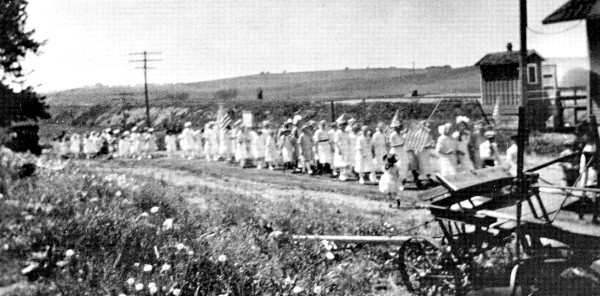
Children's Day was the highlight of the summer. A march around Main Street
following a small band and the American flag was enjoyed by the children, who
were then given an orange. During the afternoon, the girls had crock-hitting
contests and the boys had target shooting. The hall owners served a full course
supper to everyone, followed by dancing for the children. The evening closed
with dancing for the adults and a midnight lunch.
It was a sad evening when fire hit the hall and burned it to the ground. The
fire was so intense that sparks were flying over the lumber yard and our farm
buildings, endangering our buildings.
Mrs. Alvan (Elaine Schroeder) Hansen
Page 167
ODDS AND ENDS
I remember walking up and down the streets on Children's Day
when Louis Schroeder ran the Opera House, and we walked past two elderly women,
Mrs. Hollander and Mrs. Thomssen. Both had grandchildren in the parade, and
both were smoking clay pipes. That was really a rare thing in those days.
Ida (Koester) Wunder
ODDS AND ENDS
Entertainment in my youth was mostly house parties, birthday parties, and
Fourth of July celebrations. We always looked forward to the latter with great
satisfaction, as it was a break in our heavy schedule of farm work. We always
managed to have our work done so we were free to go to whatever town was
celebrating. We tried to go early so we could see the parade which was the feature attraction of the day.
Katie Rowedder, age 81 when interviewed for the Denison Bulletin August 22, 1963
ODDS AND ENDS
The band for the annual king shoot at the Five Mile
House used to be composed of local fellows, and they would march on foot to the
home of the previous year's king. My father, Claus Fred Stammer, was a trumpet
player in the band around 1900 to 1905.
Clarence Stammer
ODDS AND ENDS
People of our area had a variety of entertainment in the
"good old days." Going through newspapers of about 1886, we find
references to dances being held nearly every week, and sometimes two or three
times a week. The dances were held at the Exchange Hall in Aspinwall, the Five
Mile House and Three Mile House, and even homes such as the William Fitzsimmons
residence in Hayes Township. The events included Masquerade Balls, meetings of
the German Gun Club, and Children's Day dancing. Music was by a German Band,
the Manning Cornet Band, and by local people who played the accordion,
harmonica, violin, and other musical instruments.
Also popular were lyceums, lectures and discussions which
were held at schools such as the Valley School House in Hayes Township; Literary
Societies, which met weekly in towns like Astor; and church choirs, which were
as much a social organization as a religious one.
Women and children, and sometimes men, took train trips to area towns to visit
relatives and friends, often spending several days or a week. They also visited
each other's home to help in sewing, canning, or cooking projects, and of
course, for discussing the latest news.
And that all-time favorite, fishing, was popular "back then" too. In April, 1886, the Astor Tribune reported that "fishing is all the rage around here, with men, women and children taking part."
Page 168
SUCCESSFUL KINDERFEST
At the Aspinwall Hall last Friday afternoon and evening hundreds of people
gathered to enjoy the annual Kinderfest activities. There was a parade at 1
o'clock after which the boys and girls danced until after supper when the older
people whirled about the waxed floor for several hours. There were more than a
hundred young dancers on the floor at times and all enjoyed to the fullest the
occasion. The following were the boys who won:
1st prize Lester Rowedder
2nd prize Herbert Schroeder
3rd prize Reynold Hagge
4th prize Hugo Karsten
5th prize Herbert Rowedder
The following girls won prizes:
1st prize Viola Vehrs
2nd prize Nellie Mohr
3rd prize Malinda Brandenburg
4th prize Alta Kuhl
5th prize Caroline Dammann
Manning Monitor, June 21, 1918
ODDS AND ENDS
Upcoming Dances at Aspinwall: Sunday, July 18, West Side Orchestra; Sunday,
August 22, Han's Orchestra of Manilla; Sunday, September 5, The
Kruse Orchestra; Dance September 26, Thomsen Orchestra; October 17, Thomsen
Orchestra.
Manning Monitor, 1915
ODDS AND ENDS
ADV. Masquerade Dance, Saturday, March 4, featuring Han's Orchestra. Aspinwall. John F. Brus, Proprietor.
Manning Monitor, March 4, 1916