Lage had done extensive reading on how to organize rural electric cooperatives under the new Rural Electrical Administration (REA) program, which was started in Iowa that year. At the time, only 24,000 Iowa farms, or less than one in nine, had electric service.
In December, 100 farmers battled a blizzard to attend a meeting at the Five Mile House south of Westside. Lage announced that the city of Denison had agreed to furnish power up to 500 kilowatts at two cents per kilowatt hour. The winter proved to be one of the most severe on record; the summer of 1936 was the fourth in a row of drought and heat. The farmers continued to work toward their goal, however, and by September 21, 1936, there were 20 Crawford and Carroll County farmers ready to sign the incorporation papers. They included E.A. Wiese, Alfred Lage, Louis Ranniger, W.J. Kruse, Julius Ranniger, Herman Lage, J.W. Anthony, and Louis Stammer, all from farms north of Aspinwall; H.E. Kuhl, J.W. Vennink and B.R. Detwiler, Manilla; Louie Bauer, John Schumann, Henry Schumann, H.H. Kruse, and Henry Hagge, Westside; Harry W. Frank, Arcadia; and Louis Heiden, Con Heiden and William Nehls, Denison.
The following month, the REA approved a loan of $127,500 to the new cooperative. A membership charge of $2.50 and a minimum monthly bill of $3.50 were established.
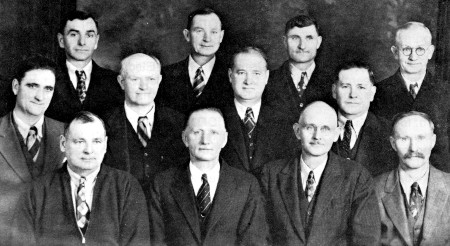
Construction of 92 miles of line was started April 5, 1937. The first line ran from Denison to the Five Mile House. The lines were completed in September, and on the 29th the lines were energized. About 300 people met at the Five Mile House to celebrate the event and to witness the formal throwing of the switch by E.A. Wiese, the first president of the board of directors.
"It was just wonderful," recalls William Kruse. "We could hardly believe that electricity was coming to us." Now 90, Kruse is the only original board member who is still alive. He said that his home 2 1/2 miles north of Aspinwall was wired for $35, and that most people first joining the system used the electricity for their homes only.
Like many businesses, the REC encountered some problems during its first years. One of the biggest was convincing people to sign up. Many farmers -- hit hard by bad weather, bugs, and low prices of the 1930s -- felt electricity was an added expense they didn't need. Others thought that rural electricity was not feasible. Some were told that if they signed up for membership, their farms would be taken away because they would be liable for the obligations if the cooperative failed.
Then came World War II, and it was nearly impossible to get materials for the construction of the electrical lines. But by the end of the war, electricity had been determined a necessity
Continued from page 135
instead of a luxury, and instead of attracting customers, the problem was getting lines constructed fast enough.
In 1938, the South Crawford REC had 382 members and 123 miles of line. There are more than 2,900 meters in use today, with M&I Dehy, Manning, and Iowa Beef Processors, Denison, using REC service as well as farmers.
ASPINWALL STREETS
For the past century, the streets within the Aspinwall city limits have
remained virtually unchanged. Today, the streets continue to be surfaced with
tar and gravel, and no paving has been done within the town. Crawford County is
in charge of maintaining the streets.
In 1970, the town map was altered slightly as the road at the east of town was
discontinued half-way between the highway and the railroad underpass. This
two-block stretch of road had been quite treacherous, going straight up what
the school children called "grassy hill."
If you wanted to do something to make your mother's hair turn prematurely gray, you told her you had just gone down the steep hill on a sled or a bike!
PAVING OF HIGHWAY 141
Iowa Highway 46 -- now called Highway 141 -- was graded and paved during the
summer of 1940. At the same time, the road connecting Aspinwall to the highway
was created from Main Street almost straight south; previously, the link was
from the town to the west and then south through the farm presently owned by the Brandt family.
The 7.8 miles between Manning and Manilla was the last of the state highway to be paved from Des Moines to Sioux City. Members of a road committee, including John A. Lewis of Manning and Chris Olson of Manilla, had worked for more than seven years to obtain federal funding for the project. Federal approval was finally given in January, 1940, through a program assisting the surfacing of state highways used as farm-to-market roads.
Although less than eight miles, the work cost more than a quarter of a million dollars: $10,751 for the one bridge and 20 culverts, $54,496 for the grading and $198,810 for the paving.
In 1980, the curbs along the sides of the highway were removed.
The bulldozers, scrapers and other machinery caused much excitement when the road paving and bridge construction were underway. Young and old watched the festivities. Chris Brandt, who was a lad of five, remembers that he and his big brother, Joe, who was six, were fascinated by the machines and the work. "We were constantly over there," Chris said. "In a way, I think the workmen enjoyed it, but we were probably a pain in the you-know-where!"
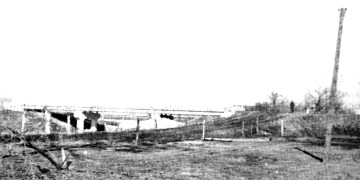
For many adults, watching the construction of the bridge a half-mile west of town was better than going to the movies. Flood lights were used by the construction crews in order to work throughout the night, so the field work could be completed before making that nightly trip "down to the bridge." Dirt was transferred from the hill east of the bridge to the bottom by huge bulldozers in order to raise the height of the bridge; this also resulted in a better access for the new road into Aspinwall.
Mr. and Mrs. Marvin Lamp, who lived on the farm next to the bridge work, were given the honor of driving the first car over the new bridge.
More than 5,000 people attended the dedication of the highway, with ceremonies and a free beef barbecue held at the Manning-Manilla Golf Course, mid-way between Manning and Manilla. Schools were closed to allow students to attend the program, which included an address by Governor George A. Wilson and music by the Monaghan Post Band of Sioux City, the national champion American Legion Band. More than 1,200 pounds of beef and 6,000 buns were purchased for the meal.
"Considerable traffic" was expected along the new highway, which would be the shortest route from the northwest to the center of the state.
It was probably also the beginning of the end for Aspinwall's railroad, for as better highways and roads came into being, trucks began taking the place of trains.
GRADING AND PAVING
According to the contract issued to the McGuire Brothers of Algona, the grading
of the 7.870 miles of Highway 46 (now Highway 141) from Manilla to Manning was
supposed to begin July 1, 1940. The work was to be done in 60 working days. The
contractor agreed to pay a minimum wage of 75c an hour to all skilled laborers,
60c an hour to intermediate workers, and 50c an hour for unskilled labor.
The three inch sloping curb -- which has since been removed -- cost .06c a linear foot, or a total of $4,645; the paving, done by Dobson and Robinson of Lincoln, Nebraska, cost $2.00 a square yard, or a total of $187,832. The paving crews were paid wages similar to the grading crews, with the work to take 50 days.
Page 137
BUILDING OF HIGHWAY
141
By Rose Brandt
The construction of Highway 141 had a lot of meaning to our
family and others along this same road. The pillars for the bridge had to be
driven and it meant damming up the water so this could be accomplished. One of
the best memories of my childhood is wading through the deep water and catching
the fish (bullheads) almost by hand, but usually with a bucket or a large pan.
There was some dynamite used, perhaps in the removal of old tree stumps along the old highway. I remember a few of our south windows were broken in the process. The huge caterpillars worked day and night to grade down an old railroad running through our land, abandoned when the new one started running through Aspinwall in 1913. This dirt and gravel was used to build up the bed of the new highway. The noise was so terrific that many times it kept us awake most of the night. The work in preparation for the cementing was all finished by June 10, 1940. That's the day my sister Margaret wrote in her diary that the men actually started working Highway 46, as it was then called. That meant the paving had begun and soon it would all be a reality, driving on a brand new road!
Our old creek had a meandering way of running, first south and then west before it flowed underneath the bridge. This also was changed on through and ever since then flooding has never occurred, as it did before, when the water would almost come up to the lower farm buildings.
Then May 10, 1941, the "New Highway" was opened and everyone felt the experiences were well worth going through. It was a grand feeling and the memories of it will never be forgotten.
ODDS AND ENDS
Eddie Dahleen, my husband, an employee of the Aspinwall
Co-op at the time, broke his back in May of 1959. While delivering gas to the
George Hunter farm, he was filling the gas barrel, using a folding ladder which
was furnished by the Co-op. The ladder collapsed, and Eddie fell, hitting a
wheel rim laying on the ground. In spite of immense
pain, Eddie returned to Aspinwall, and delivered drums of oil to the Allen
Nissen farm. By that evening the pain was so severe that Eddie paid a visit to
Dr. Hennessey at Manilla, who advised him to go to the hospital for X-rays.
They soon discovered his back was broken and a body cast was applied which he
wore for three months. After the cast was removed, Eddie was then put into a
body brace, which was worn for an additional three months.
Darlyne Dahleen
ODDS AND ENDS
I used to stand on our front porch and watch the farmers drive their cattle to
town with horses and the help of their neighbors. Their herds were often so
large that they filled the entire town. There were also a lot of sheep brought
in and shipped out of the stockyards, which needed two or three men working
there to keep up with all the traffic.
John Babik, Omaha
Page 138