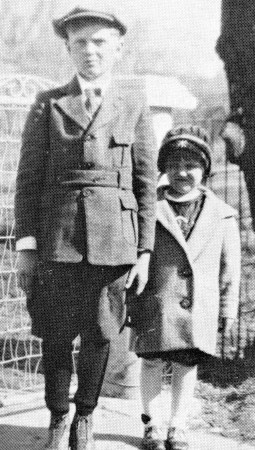
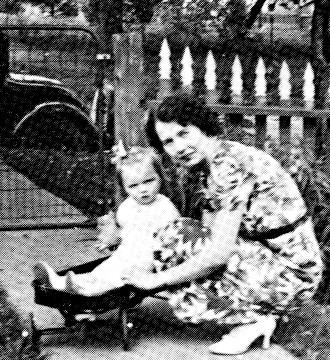
Dorothy Ehrichs and her big brother Glenn, shown in 1927.
Every pupil who ever walked through the doorway of the Aspinwall School surely has many memories of the days spent there. The memories are varied, and many are lost forever, but we were fortunate to have many people come forth with their recollections. The white schoolhouse on the hill seemed to stand there with calm dignity, and youngsters of all ages came to respect the activities which took place within its walls.
Generally, the school term was from September through May; school closings because of illness, extremely bad weather, or corn picking "vacations" could prolong classes into June. In the very early years, school was sometimes in session only in the winter months. Some years there was one teacher for all eight grades; more often, our Aspinwall School had two teachers. Originally, the school building was partitioned, giving it rooms on the south and north sides. Later a permanent wall was installed, dividing the building into east and west rooms. The section for grades kindergarten through fourth was called the "little," "low," "primary," or "kindergarten" room; "high," "big," and "upper" referred to the room for grades five through eight. During at least one year, a ninth grade was added to the school.
Other buildings on the school grounds included a coal/cob shed, the "out" buildings, and a cave, where we could take shelter in severe weather. In winter, the teacher or older pupils used the coal shovel to scoop a path to the outside toilets, and swept "out" the snow with a broom. There were so many trees on the school grounds that one teacher referred to them as "a forest."
There was a wooden fence on the north, east and south sides of the grounds. On the west side, a wire fence divided the school grounds from a pasture, and many times cattle stood along the fence.
During most school years, a slide and several swings were located on the school grounds, but throughout the years the swing and slide were moved to various places: sometimes east of the coal shed, other times west of the school between the "little houses."
A TYPICAL SCHOOL DAY
What was a typical day like in the Aspinwall School?
Before leaving for school, many of the farm children and some of the kids from town had chores to do. There were chickens to feed, livestock and pets to feed, and milking to be done. Some had to help separate the cream from the milk before leaving in the morning. The country children generally walked to school, but some rode horses. Elaine (Schroeder) Hansen recalls riding her horse "Dan" to school and tying him to a post or fence. If she went home for lunch, Elaine rode her horse; if she stayed at school for lunch, she would turn Dan loose to go home by himself.
Usually the teacher was a young man or young woman; men were prevalent from about 1895 through 1909, and women in years after that. The teachers often boarded with a family in or near Aspinwall, and salaries were as low as $35 per month.
The teacher, if only one, taught all grades and all subjects. He or she was also the janitor and kept the schoolroom clean, carried in the fuel for the pot-bellied stove, and started the fire. And, all the former pupils have agreed, the room was always warm right after refueling and they often burned themselves on the hot stove.
How studious a pupil would become sometimes depended upon the seating arrangement, and more importantly, on the size of the desks. At the beginning of each school year, the teacher was faced with the
Continued from page 101
task of selecting desks to "fit" each pupil. Many of the "little ones" still had to sit with their legs swinging, because their feet could not reach the floor. Sometimes a kind school board member or the pupil's father would nail a block of wood to the floor under the desk so the tiny one could rest his feet.
The teacher arrived to school about 7 or 7:30 a.m. each day, started the fire, swept the cement steps in warm weather, or scooped the snow off the steps during winter. If the lessons for the day had not yet been prepared, this too had to be done before the children arrived.
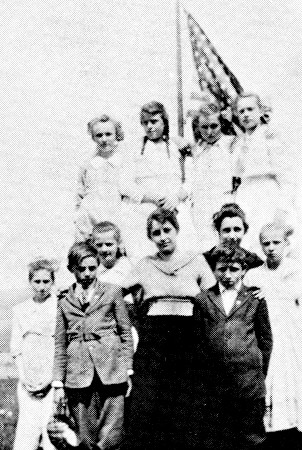
The bell in the cupola was tolled at 8:30; school started at 9 a.m. Morning classes were opened with the Pledge of Allegiance, followed many times with the singing of "America" and other patriotic songs. In warm weather we gathered outside by the flagpole for the ceremonies.
Before settling down to their studies, the students did exercises such as "Jumping Jacks" or "Running in Place." Exercises were often done to phonograph music, many times to marching records, or to piano music.
Health inspections -- teeth brushed? hands and nails clean? hair combed? -- usually also occurred before classes began in the morning.
The first period was a busy time: reading, writing, and arithmetic... memory work and more memory work... recitations... and also during this time the older children would take turns to "fetch" the drinking and washing water. The children would carry the bucket between them, usually down and back up a steep hill such as "grassy hill." Originally, everyone used a long-handled dipper to drink from; later, each child was supposed to have his own cup to dip into the common pail. The cups were sent home Friday nights for washing, and sometimes forgotten Monday morning.
Later, the drinking water was poured into a Red Wing stoneware cooler, which had a spigot on the bottom front side. This was such a common sight: the drinking jar and the wash basin (the basin was emptied at various times during the day by carrying the basin and water outside the school, up over the cave, and giving the contents a "fling").
Cloth handkerchiefs were in daily use before paper towels were available, and a single cotton towel or a cloth towel on a roller were used by everyone.
Is it any wonder that sickness was prevalent and traveled quickly through an entire school?
The morning recess period was about 15 minutes long, beginning about 10 or 10:15. During good weather, the children were sent outside to play and get some fresh air. Popular games were Pom-pom Pull Away, Tag, Hop Scotch, Alley Oxen in Free, Ring-Around-the-Rosy, Andy Over, Run Sheep Run, and Fox and the Goose. Of course, the swings and slide were always popular, and we never tired of playing ball.
In season, sleigh riding was always a favorite, and if the weather was too bad -- either rain or snow -- there was always the hall. This was an important part of the school building; as the entry way, it held the coats, boots, lunches, and was referred to as "out in the hall" or the cloak room. I doubt if any Aspinwall pupil can say he or she never played "keep away" in the hall. The coats were knocked down, boots originally neatly arranged were scattered and mixed up, and many elbows were bruised in the confined play area.

Page 103
My School Memories
The bell calling class time was sounded.
Morning studies were then resumed, perhaps practicing the Palmer Writing Method by following the huge example displayed across the top of the blackboard. Remember the "circles"? Someone at the blackboard would drop a dusty, chalky eraser or deliberately scratch a fingernail across the board... this HAD to be the morning a mouse scampered around the floor and the teacher stood on a chair while the children laughed at her fright and scrambled to corner the mouse.
LUNCH TIME
Twelve o'clock, noon, was lunch time, and both teacher and pupils were ready for the break.
The lunch box was created from containers found in the home: lard pails, molasses or syrup buckets, metal tobacco boxes, and so on. School lunches included sandwiches of bread and butter (or fresh lard during the spring butchering time) with homemade sausages, cheese, syrup, jelly, or other spreadable goodies. Home grown fresh fruit, especially apples, or a fruit jar of soup were often included, and homemade cookies were a special treat.
The lunch pails were kept in the entry hall on the benches, and when the weather was very cold, the lunch and beverage were often frozen by noon.
Water was heated on the top of the stove so the children could thoroughly wash their hands before eating their lunches. The meals were eaten at the desks, or in nice weather, out on the school steps, sitting around on the "hump" of the cave, or under the trees. After lunch, the usual games and activities were enjoyed; perhaps someone missed too many spelling words or arithmetic problems and had to "stay in" and work.
The bell rang at 1, and after lunch, opening exercises often consisted of the teacher reading a portion of a continued "favorite" story. During this time, the children were sometimes allowed to sit together in a desk and could choose the partner.
"Was that a noise in the hall?" Without even a knock the door would open; yes, you guessed right. In walked the Crawford County Superintendent of Schools for one of his frequent visits.
Or, a hand was raised. "Teacher, I'm all finished with my work. May I play in the sandbox? Please, if I am very quiet?"
Or, "May I get a book from the library?"
We could not let the pupils get tired at that time of the day; perhaps we'd have a "spell down" or a "multiplication contest."
The numerous signs would indicate it was getting close to afternoon recess time... and then 2:30 would come. More play or small chores. The students would help clean erasers, bring in coal and cobs, help straighten books in the "library," and smooth out the sand in the sandbox. At 2:45 there usually was a scramble to get to the bell rope first, and again the bell would ring to announce the start of classes. More studies. And just before closing, perhaps if there was time and if the erasers were all dusted and the other chores done, there would be more singing to songs like "Dixie" or "My Old Kentucky Home."
Parents and other visitors often came at this time of the day.
Finally, 4 p.m. would arrive and school was over for the day. How wonderful in warm weather just to run home... but in winter there were the coats and boots and scarves, one over the head and one over the face as well, and mittens. And DON'T FORGET THE LUNCH BUCKET!
Page 104
Picnics and Playtime
An annual picnic was held at the end of the school year. Sometimes teachers and
pupils (and maybe parents, too) enjoyed the picnic in a corner of the school
yard; perhaps it was a wiener roast after raking leaves and sticks in the yard.
Or, sometimes they walked quite a ways to have the picnic in a grove, such as
the Bohnsack grove one mile east of Aspinwall.
School programs to which parents and friends were invited were held once or twice a year, usually at Christmas time and perhaps in the spring. Sometimes a pie social was held at the same time.
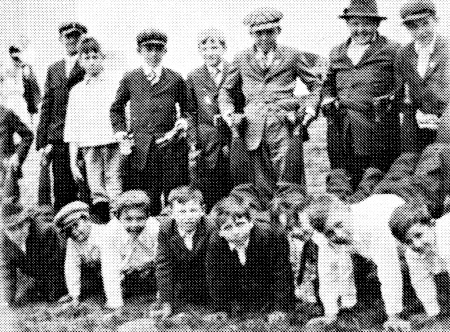
Aspinwall school pupils often competed in competitions, like races or high-jumping, with some of the surrounding rural schools.
The school library was never very adequate. Text books were purchased by the parents and passed down to each of their children.
"Andy Over" was a popular game throughout the years in our school. Also called "Andy Over" or "Anthony Over," the earliest record of the game goes back to 1872. St. Anthony was credited with finding lost objects, and the object of this game was to throw the ball in the weeds.
Teams were chosen and each side moved to opposite sides of the schoolhouse. A member of Side I would attempt to throw the ball over the building, at the same time shouting "Andy Over." If the ball failed to go over the building, the opponent (Side II) would yell "Pigtail." If the ball did go over, the one who caught the ball would run around the schoolhouse and throw the ball, attempting to hit the dodging children.
ODDS AND ENDS
When I taught school in Aspinwall in the early 1940s, the Brandt children
brought a big turtle to school. They carried it all the way from their creek in
a big bushel basket. What could we do with this turtle? We put it in the coal
shed and it got out of the basket. It caused quite a bit of excitement.
Dorothy (Ehrichs) Kusel
ODDS AND ENDS
One party, in particular, I remember was a Halloween party.
The older kids were in charge and us little kids were
the "victims"! I remember they scared us to death. There was a lobby
entrance to the school and the kids hung up curtains for the party; they were
on the far end of the lobby. One at a time they made us little kids go through
... it was pitch dark in there with all types of rubber spiders and skeletons
on strings suspended from the ceiling which we bumped into. Then they grabbed
you and smeared your face with soap. We couldn't see what was going on and it
didn't take long to find the way out!! I still remember how scared I was.
Myra (Weems) Luetje
ODDS AND ENDS
A couple of things I remember about school so well: going down the "grassy
hill" to the pump by Carl Schroeder's pasture to pump pails of water for
school, sometimes taking the shortcut through the pasture if there weren't any
cattle too close. Also, I still have a picture I colored in kindergarten which
I dropped on the corner near my home, going home from school. It still has the
mud splatters on it.
Donna (Schacht) Mahnke
ODDS AND ENDS
I remember going to the two room schoolhouse on top of the hill from our place.
Friday afternoons we were allowed to play games from recess time to dismissal
time. Sometimes on nice days we were allowed to do our lessons outdoors, which
was a treat.
Malinda (Ehrichs) Anderson
ODDS AND ENDS
I remember my wonderful first pupils in 1941. We did so many things together in
study and play ... that was a happy year.
Dorothy (Ehrichs) Kusel