THE MANNING-MANILLA GOLF & COUNTRY CLUB
On the 20th day of April, 1931, the following group of organizers and Charter members signed as witnesses to the writing of the articles of incorporation for the formation of a golf and country club: G.A. Rober, Alfred Kuhl, Arthur Rix, John Frahm, J.R. Hansen, Wm. Ohde Sr., A.F. Smith, Henry Hoffmann Jr., A.A. Danielson, Julius Wehrmann, F.D. Ross, Fred Timmerman, J.J. Sinn, F.W. Bauer, and H.A. Schelldorf.
The name of the club as listed in Article I of the Articles of Incorporation was the ManningManilla Golf and Country Club, with general business to be conducted in the city of Manning.
The capital stock would be $20,000, divided into 800 shares at a par value of $25 each.
The first board of directors were Dr. J.J. Sinn, A.A. Danielson, G.A. Rober, Wm. Ohde Sr., Dr. A.F. Smith, John Frahm, all of Manning, and R.W. Barber and Dr. C.I. Anderson of Manilla. The first officers were Dr. A.F. Smith, pres., A.A. Danielson, vice-pres., Henry Hoffmann Jr., secretary, and G.A. Rober, treasurer.
Dues were $20 a year for playing members over 21, their wives or husbands, and children under 15. A single child between 18 and 21 of any playing member paid $10 per year. A child of a playing member whose age was between 15 and 18 paid $5 per year. Greens fees were 50c a day or $2 per week, with a maximum of two weeks in succession.
The idea of a golf course for Manning was instigated by J.R. Hansen and A.A. Danielson, a man of golfing experience who came to Manning to manage the Dultmeier Manufacturing company. Discussions were held with several businessmen, and a group was formed to investigate the possibilities of buying land for a course. One of the sites considered was the Great Western Park, with its spring-fed lake and proximity to town. When it became known that a group of businessmen were looking for land for a golf course, the asking price per acre rose so much above the average price that it had to be given up. Finally the group found an 80-acre tract of land five and a half miles west of Manning on old Highway No. 41 (now 141) that could be purchased for $80 an acre. The site was chosen because it was approximately halfway between Manning and Manilla and so could be a project supported by the two towns. Thus it was named the Manning-Manilla Golf and Country Club.
G.A. Rober financed the plan by purchasing the land and was gradually paid back through the sale of shares of stock.
G.A. Rober and J.R. Hansen then conferred with Jack Sherman, the professional grounds expert at the Elmwood golf course in Omaha, about the lay-out for the local course. Mr. Sherman came to Manning and planned the lay-out, and promised that according to the favorable contour of the land, it would develop into one of the sportiest nine-hold courses in this area.
There have been only a few minor changes since that time. Play began in the southern part of the 80 acres, which was a pasture large enough to accommodate three sand greens, and so for a few months it was literally "cow pasture pool". The stream that flows through the course now requires a 20-foot long bridge for crossing; the original lower area was narrow enough to jump across. It was no problem for the golfers, since no one owned even a pull cart.
Volunteers, including local Boy Scout troops, cleared the rest of the land of corn stubble and groomed it for nurse crop planting. It wasn't long before sand greens began to be replaced with bent grass and the course began to shape up with the planting of hundreds of trees.
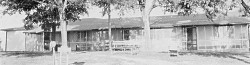
The board appropriated $8700 for the building of dams, bridges and a building, which was a machine shed located just below the upper pond on the west edge of number nine fairway. Men's night was held by everyone bringing his own sandwiches and thermos. Scores were tallied and lunch eaten as players sat around on the machinery in the shed or out on the grass. Th first club house was built in 1935 by volunteer labor and contractors. Several years later a severe wind storm heavily damaged the club house and again volunteer labor rebuilt and enlarged the building. In 1960 volunteer contractors and laborers modernized the building again and added the large dining and meeting room on the south elevation.
The first club tournament was won by Arthur Eden.
Today the course is a challenging par 36 nine-hole lay-out with fine bentgrass greens, elevated grass tee-offs, and an underground watering system to provide automatic sprinkling for the greens. Two large parking sheds have been built to accommodate the 78 gas and electric golf carts owned by the players.
The club counted among its members two widely known fine golfers. Bob Leahy came to Manning in 1959 to become the high school principal. At that time he carried the title of Iowa Masters champion for 1953 and 1957. He represented the local club in the first tournament of club champions held at Atlantic, and was the first winner in 1959. He repeated again in 1961. He also won the Iowa Amateur in 1954, 1955, and 1957. Bob is now the Registrar at the University of Northern Iowa.
Bruce Fischer, son of Mr. and Mrs. Eddie Fischer, at the age of 12 startled many a local adult golfer who would condescend to let him "play along". The match often ended with Bruce a four or five stroke's winner, but the softspoken, well-mannered boy always expressed his thanks for the privilege of playing with an adult.
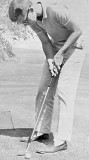
His natural ability and love for the game quickly brought him into prominence. At the age of 15 he qualified for the U.S. Junior National Amateur tournament at Kansas City. He was the only Iowan to survive the first round and went on to play and win four more matches to gain the semi-finals. He lost this round on the 19th hole in a play-off. The following year he qualified at Decorah in the state meet for the international J.C. tournament and played at Denver, Colorado. That same year he was one of three Iowa boys to qualify in Des Moines for the U.S.G.A. national Junior tournament and played at Ithaca, New York.
He qualified for the Iowa State Junior tournament for players below age 18 in 1960, 1961, 1962 and 1963. In 1962 he took second and won the trophy for the lowest qualifying score and also the sportsmanship trophy.
In the Herman Sani tournament at Des Moines, he won a golf scholarship of $350 for four years at the college of his choice. He was also the recipient of the Rotary Club certificate of merit for his participation in the state, national and international tournaments, and his wins at Fort Dodge, Storm Lake, Spencer, Atlantic and many others.
Bruce Fischer and Bob Leahy tied for the local 9-hole course record at 27 strokes.
Bruce went on to attend the University of Iowa, but an illness that forced him to come home caused his death at the Carroll hospital February 21, 1965.
A scholarship fund was established at the local school in his memory.
Today, besides golf, the course is used for cross country track meets and high .school golf competition.